
Utica Resident Lookup Records
No single official source establishes who lives at every Utica address. The right record depends on the question: a parcel record can identify land and its posted fields, a directory can show a dated printed listing, and a court system can show only the cases available in that system. Record the source date beside every result. That simple habit prevents an owner, mailing address, document party, and historic resident from being treated as one fact.
| Record | What It Confirms | Where | Access |
|---|---|---|---|
| Property and tax record | Parcel geography and posted owner or mailing fields where available | Utica tax self-service and assessor materials | Online property route; not an occupant list |
| Historic directory | A printed name and address association for one edition | Utica Public Library | Selected online editions and in-person research |
| Electronic court search | An accessible e-filed case or current case-status result | NYSCEF and eCourts | System-specific; exclusions apply |
| Vital-record route or index | A restricted certified record, historical request, or finding aid | NYSDOH, City Registrar, or State Archives | Eligibility and date rules control |
| Professional license | Status fields for a selected profession | NYSED verification | One profession per search |
| County custody list | Current information within the Sheriff's listed system | Oneida County Sheriff | Not a complete history or identity proof |
When an old address is the starting point, the historic association belongs with the Utica City Directory collections. When the goal is a present record, use the current custodian and preserve its stated scope.
Verify a Utica Resident Lookup
Verification is about matching record roles, not collecting the most results. First anchor a name to one well-defined fact, such as a dated directory entry, a parcel identifier, a case number, or a license number. Then find a second source that can independently test that fact. A pair of name-only matches is still unresolved, especially with common surnames or initials.
- Write down the exact name form, date range, locality, and the record question you are trying to answer.
- Use the system that owns that record type, and save its source date, identifier, and the fields actually displayed.
- Compare a second source only when its date and purpose fit, such as a period directory and newspaper or a parcel record and recorded deed.
- Check conflicting spelling, middle initials, addresses, party roles, and dates before describing a match as likely.
- For a restricted record or an unclear result, ask the custodian for its authorized process instead of filling gaps with an inference.
An exact parcel ID across City and County mapping can be described as a parcel match, subject to date. The same exact address in a dated directory is a historic address listing, not proof of current residence. A name plus a document type and town in the County Clerk index remains a possible document match until the image and parties are reviewed.
- Docket
- The court's record of a case and its activity. A docket result identifies a case process, not a full account of a person's life.
- Index versus image
- An index points to a record or case; an image is the reproduced document. Access to either can be limited, and an index entry needs review in context.
- Certified copy
- A copy issued and certified by the custodian. For vital records, the current eligibility rules decide who may obtain one.
Utica Court Search Fields
NYSCEF Case Search is the statewide route for electronically filed cases, not every court record. Its documented search options include a case identifier; party or business name; first and last name with optional middle name; court; county; case type; filing-date range; and a specialized tax-cert or SCAR block-and-lot route. Narrowing by court, county, and date helps separate same-name results, but it does not prove identity by itself.
Use eCourts for current case status in participating courts, then contact the Clerk for the authorized record route when needed. Sealed and confidential matters are not public through these systems. The Oneida County Clerk says qualifying civil Supreme Court actions from 1992 to the present are searchable through IQS unless sealed or confidential; County Court criminal files are not searchable online. A public-terminal review may be available for accessible files, and a name/timeframe request can take up to 24 hours.
See the New York eCourts entry page for the participating court status route.
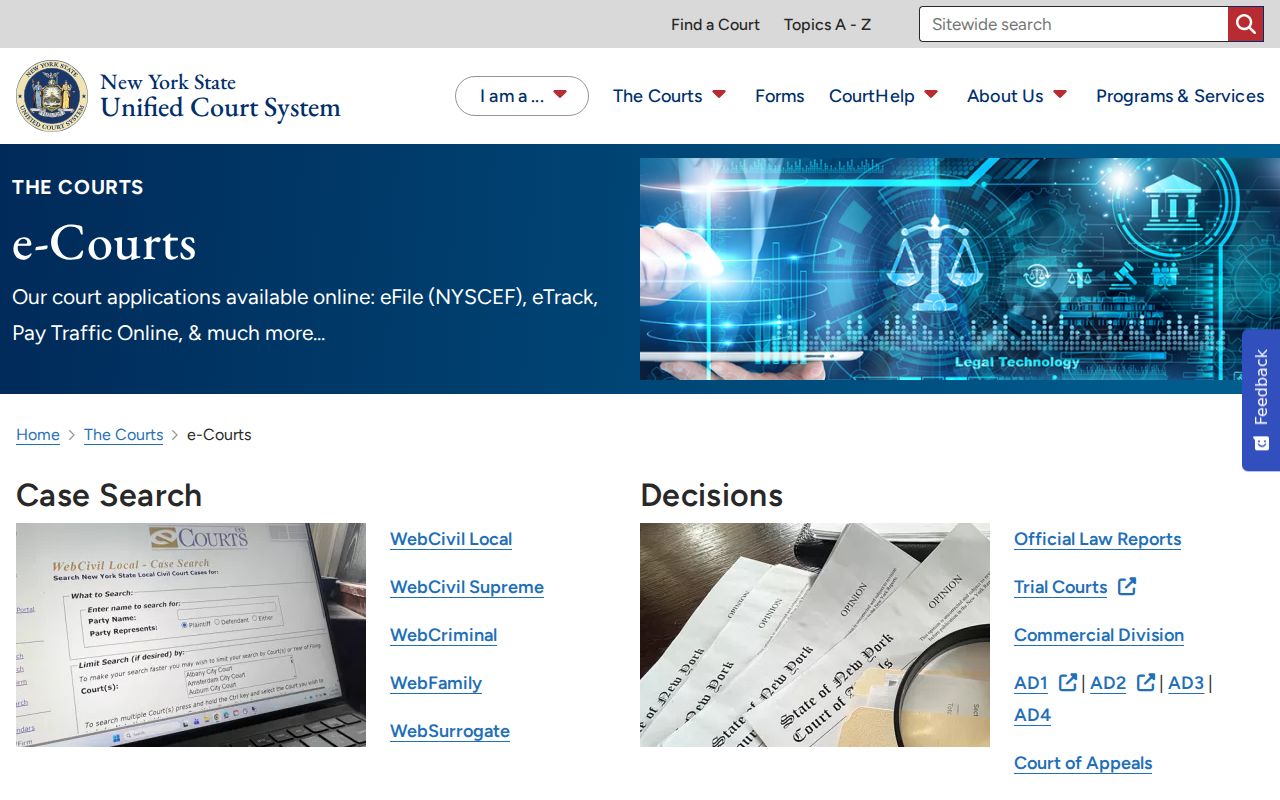
A status screen is useful for its own case system and should not be read as a complete court search.
The Oneida County Clerk court-record guidance explains the local civil, criminal, terminal, and request distinctions.
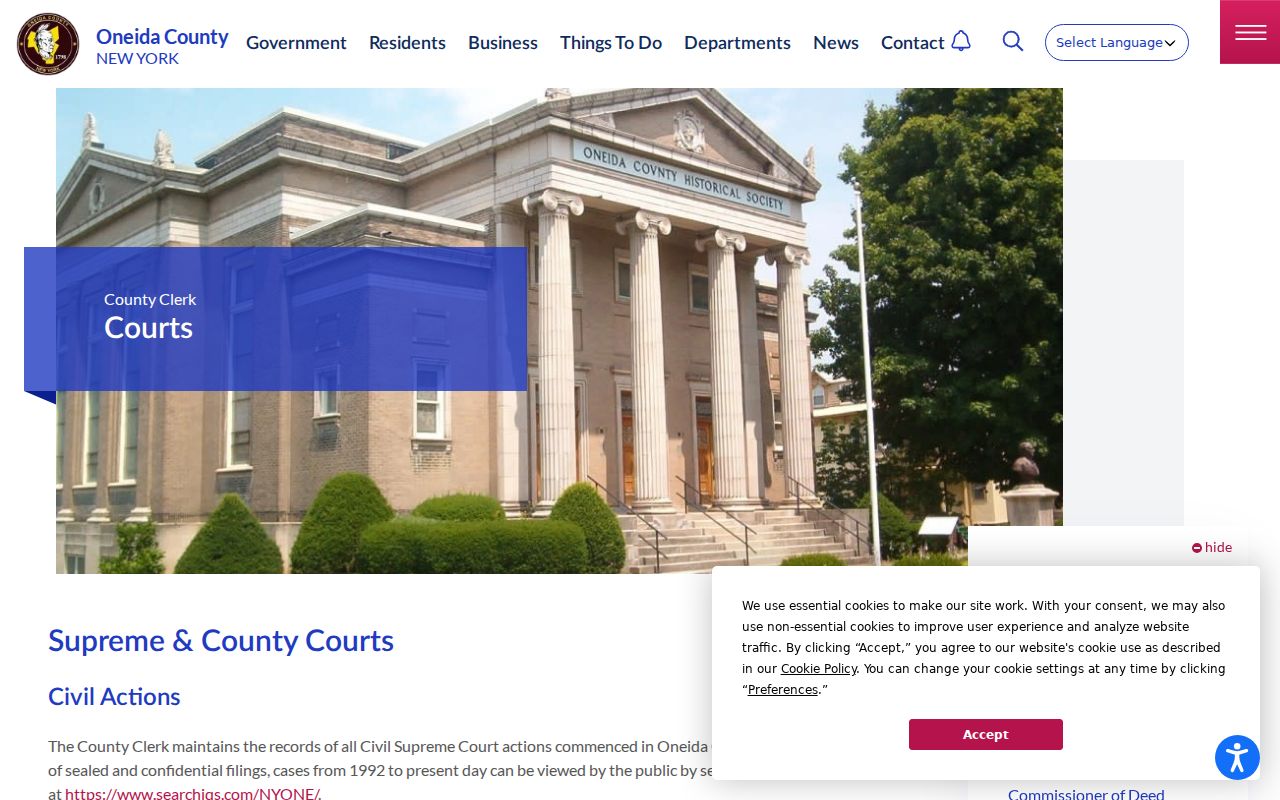
For any accessible match, compare the case number, court, filing date, and party role before relying on a name.
Utica Vital Records Split
Vital-record access is not a general lookup. The City of Utica Vital Records office keeps City birth and death records from 1876 forward and labels them confidential. For a City certified birth certificate, the City identifies the person named on the record or a parent as eligible. Its posted mail route calls for the application, a photo-ID copy, a $10 money order, and a self-addressed stamped envelope. The City says a birth at St. Luke's Hospital after May 1957 must be requested from the New Hartford Town Clerk, a local custody exception worth checking before applying.
For records held by the State outside New York City, NYSDOH posts a $30 certified-copy fee and a 10-12 week regular-processing estimate, while event-specific eligibility controls access. Its genealogical route is different: births must be at least 75 years old with the subject known deceased; deaths must be at least 50 years old; marriages must be at least 50 years old with both spouses known deceased. The posted genealogy scale starts at $22 for a one-to-three-year search, and the State estimates eight months or more.
Review the Utica birth-certificate instructions before submitting a City request.
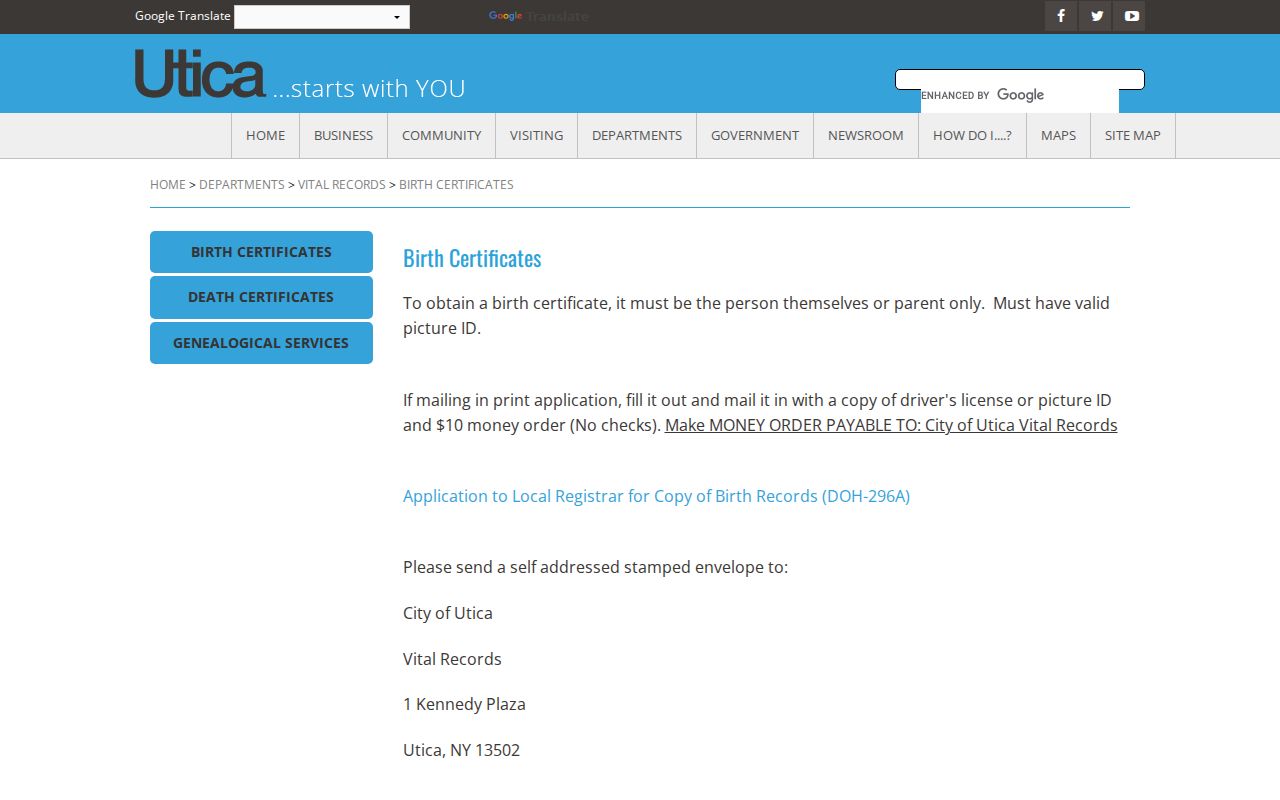
The instructions are an eligibility and application route, not an open index of residents.
The NYSDOH genealogy route documents the separate historic-request process.
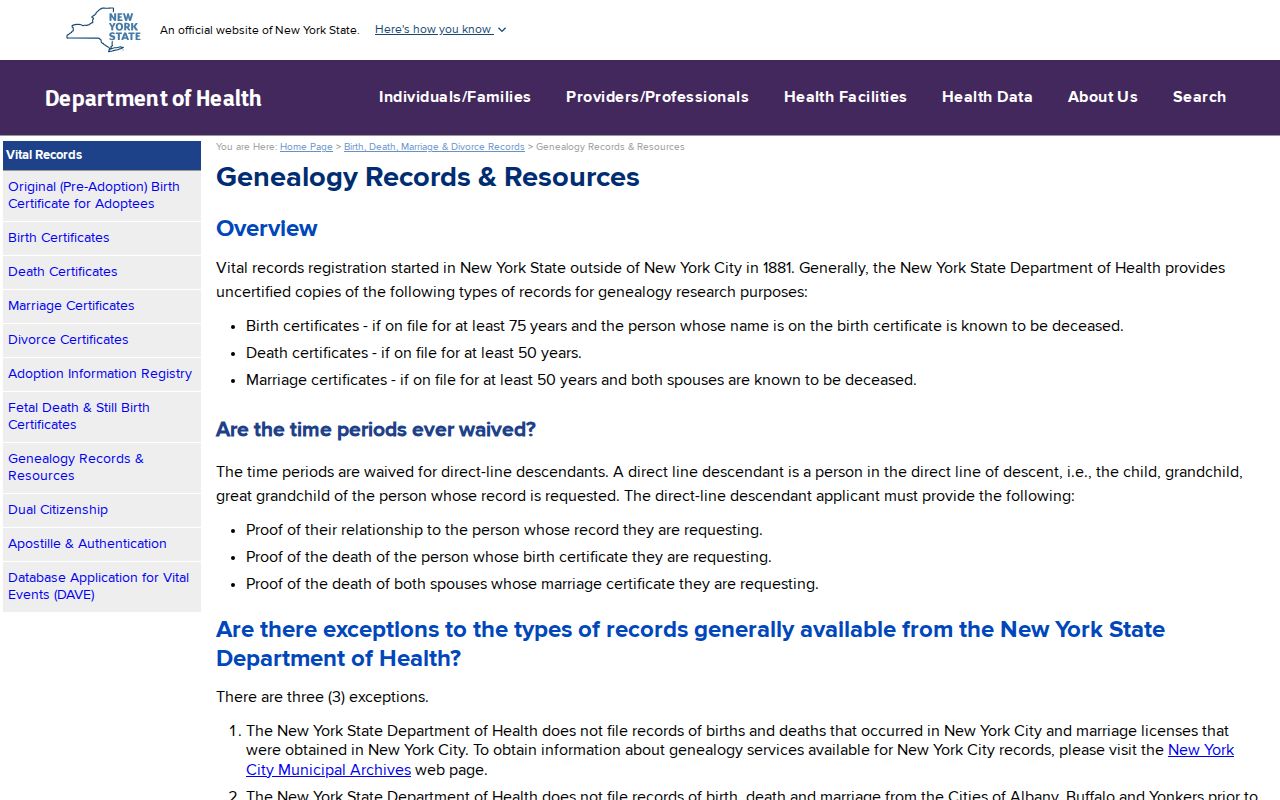
Keep a historical search result separate from a certified record, and check the State page for the current requirements before sending documents or payment.
Utica Archive and License Indexes
The New York State Archives name-index search uses a last name, optional first name, and topic selector. It is a series-by-series finding route, so the selected topic and date span matter. The Archives vital-record guide says State registration outside New York City began in 1880 for deaths and in 1881 for births and marriages, with incomplete statewide compliance until 1913. Its historical-index guidance uses a 75-year birth window and 50-year marriage and death windows. An index entry is a finding aid, not the certificate.
For a credential question, NYSED's Office of the Professions verification covers more than 50 professions. Search one profession at a time with at least three letters of the last name, then a space and first name if used; a license number requires all six digits, including leading zeros. Results may show name, profession, license number, location, issue date, registration status, and certain discipline information from January 1994. That is license-status information, not confirmation of a current address.
Use the State Archives name-index search to choose a documented index series.
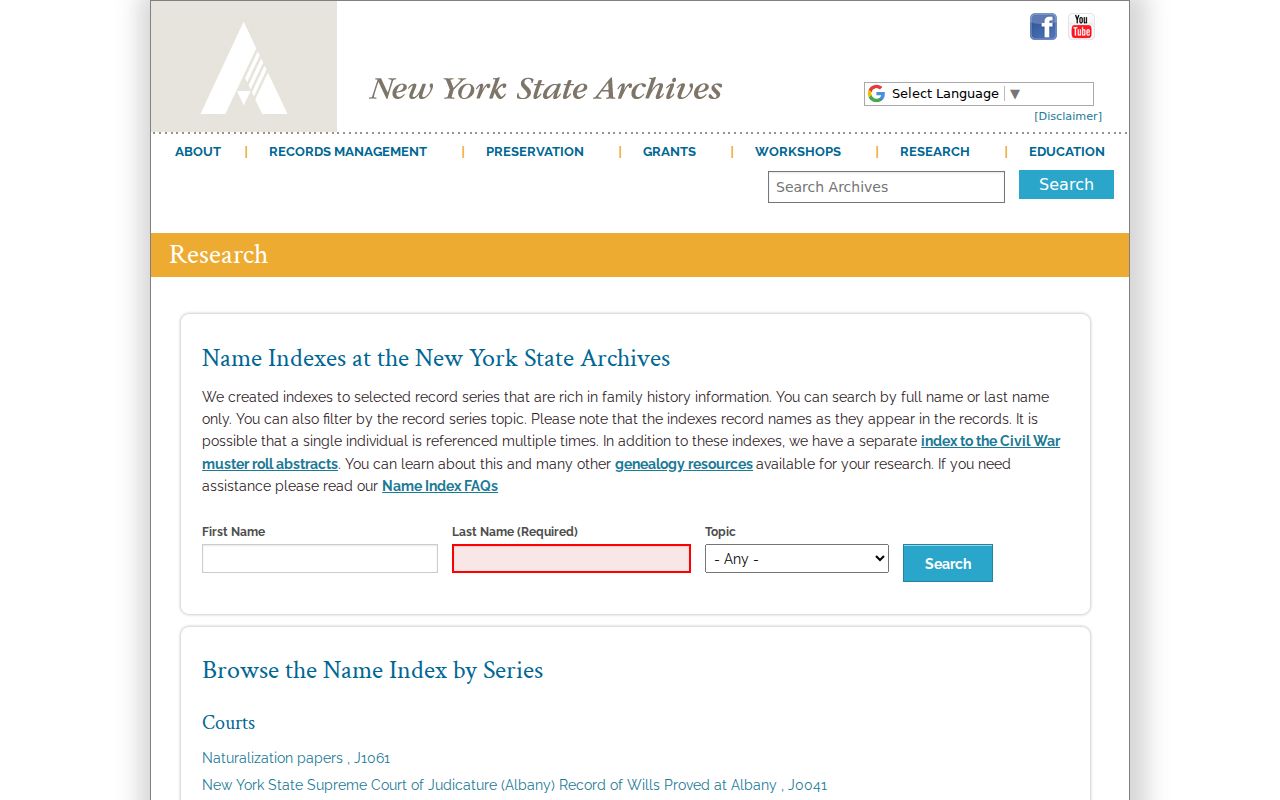
Its topic selector makes the series scope visible before a name is treated as a meaningful historical lead.
Oneida Custody Search Scope
The Oneida County Sheriff inmate list is a current-custody source, updated about every six hours. It is not a court disposition, a conviction record, a complete history, or identity proof from a matching name. Questions about the list belong with the Sheriff's records office at (315) 768-7804. The State correctional-facility lookup is a different system that searches State custody by DIN, NYSID, name, and birth year.
A listed booking is best read as a time-bound record within the county system. Keep its date and displayed labels with the result, and do not merge it with court, property, or vital-record material based on name alone.
The Sheriff's published list identifies these displayed fields:
- Name
- Sex
- Race
- Age
- Booking date
- Charges and charge details
Note: County-jail and State correctional records have different scope, so a negative search in one system does not answer the other.
Utica Resident Lookup Limits
New York access rules change by record type. FOIL does not remove vital-record eligibility rules, court seals, voter confidentiality, or address-protection requirements. The Address Confidentiality Program provides a substitute address and mail-forwarding process for eligible participants. Election Law §5-508 also protects qualifying confidential voter registration. A public form with fields for an individual search is not permission to bypass either protection.
Vehicle information has a separate limit as well. New York DMV guidance says a user may not use a license plate or VIN to find an owner's name, or a name to find a driver's address. Do not use unrelated records to work around a restricted source. If an entry looks wrong, use the responsible agency's correction, appeal, or contact route and preserve the source that caused the concern.
Lawful use. Use public record information for personal, lawful research and stop at every posted restriction. Never use it to stalk, harass, threaten, or harm another person.
Utica Lookup Request Paths
When a City or County administrative record is not posted, a focused New York Freedom of Information Law request can be the correct fallback. FOIL is Public Officers Law article 6, §§84-90. A reasonable request identifies an existing record, the department, a date range, and a record type. Agencies must generally make a record available, deny it in writing, or acknowledge receipt within five business days, subject to the statutory response process.
The City of Utica FOIL form goes to the City Clerk and Records Access Officer, with email, mail, physical delivery, or electronic-delivery choices on the form. For a deed, judgment, map, or accessible court record, use the County Clerk's direct search, public-terminal, copy, or directed-request process first. The County's public-computer research is free; copies carry the posted 65-cent-per-page rate with a $1.30 minimum. A request should seek an identified document, not ask an office to build a person profile.
Compare Utica Lookup Evidence
For a Utica resident lookup, the strongest comparison is between sources that answer the same narrow question. A City or County parcel match can support parcel geography. A dated directory and a period newspaper can support a historic association. A court identifier and the correct court can support an accessible case finding. None of those labels becomes proof of a present residence merely because the same name appears elsewhere.
Use clear labels: “property record,” “historic address listing,” “possible recorded-document match,” or “unresolved name match.” This comparison keeps a useful lead from turning into an unsupported identity statement.