
Utica Previous Residents by Era
Different source types carry different spans of Utica history. Begin with the source closest to the event or address period, then work out. The County describes most land-record and judgment access from the early 1990s forward as online, while older material may be at the Clerk. The Library’s scanned directory collection begins much earlier, yet it is a selected run rather than an unbroken series. The table separates a document trail from a household trail so that previous residents are not confused with deed parties or tax-mail recipients.
| Historical source | Era it reaches | Utica access point | What it can add |
|---|---|---|---|
| City tax and assessment record | Current or recent tax year; tax history from fiscal 2011/12 | City tax self-service and Assessor | Parcel, property location, assessment, owner or mailing fields |
| Recorded documents | Most land records and judgments from the early 1990s onward online, per County | SearchIQS, Clerk terminal, archival books, or directed request | Document parties, recording date, and recorded reference |
| Utica city-directory scans | Selected years from 1817 through 1951, with gaps | Utica Public Library digital collection and Genealogy Room | Dated printed name, address, trade, and residence notation |
| Sanborn map | April 1884 issue | Library of Congress digital collection | Street layout, buildings, and block context for that issue |
| Newspapers and census tools | Years depend on the particular collection | Utica Public Library and historical repositories | Context to test a name, place, and date against a directory entry |
Use the City parcel trail for a recent transfer. Use a directory edition near an older event. If an online path ends, the County Clerk’s search and request guide identifies free public computers, archival books, and the directed search-request procedure. UPL’s staffed Genealogy Room, the State Library’s noncirculating microform holdings, and the Oneida County History Center’s appointment-based research service are further documented alternatives.
Utica Parcels Start a Backward Trail
Before tracing past residents, write the present address exactly as the City tax screen and County map use it. City tax self-service accepts a house number and street name, a Parcel ID, or a Bill number. For the address route, the City says to enter the street name without ST, AVE, or LN. Save the source year, parcel ID, property location, and any owner or mailing field as separate facts. The City’s assessment roll visibly treats property location and mailing address as different fields.
The County parcel viewer is the useful check on geography. It maps the parcel and can display owner, address, assessed value, acreage, imagery, and County layers. It does not prove who lived at the site. When a recent tax record produces a party name or deed reference, that becomes a lead for the County Clerk route. When it does not, retain the parcel information and ask the Clerk which documented search or request channel fits the record sought.
Note: A current parcel is a starting reference for a house history, not a shortcut to a complete past-resident list.
Trace Utica Previous Residents Through Deeds
The recorded-deed trail can establish transfers, not every person who lived at an address. The Oneida County Clerk directs guest users to SearchIQS, where the documented path is Party 1 entered last name first, document description set to DEED, a result chosen by name, date, and town, then View and Print/Download. Because the published directions do not verify an address-to-deed field, a party name, parcel clue, public terminal, or directed request may be necessary before the chain can move back.
- Record the current parcel, property location, source date, and any visible deed reference from City assessment or tax material.
- Find the relevant purchase deed using the County’s documented party, document-type, date, and town sequence.
- Copy the grantee, grantor, recording date, document type, and liber, page, file, or index reference exactly as the document shows them.
- Use the prior transfer party as the next lead, then repeat while preserving the document sequence and legal description.
- For an online gap, move to the Clerk’s free public terminals or archival books, or submit a narrowly directed records-search request rather than declaring the trail over.
- Grantor
- The party conveying an interest in a recorded document.
- Grantee
- The party receiving that interest in the document.
- Chain of title
- The sequence of recorded transfers used to trace an interest in the property backward.
- Legal description
- The land description carried in a deed or related record. It can remain useful when a street number changes or is uncertain.
Utica Directories Mark Their Gaps
UPL’s digitized Utica City Directories begin with 1817 and reach selected 1951 years. The online run includes 1828; 1832–34; 1839–40 through 1868–69; 1869–70; 1870–76; 1879–80; 1882–84; 1886–90; 1892–99; 1902; 1905–09; 1911–12; 1914–17; 1919–21; 1923–24; 1926–28; 1930–33; 1935–43; 1945; 1947–49; and 1951. It does not display every year, including gaps such as 1877–78, 1881, 1885, 1891, 1900–01, 1910, 1913, 1918, 1922, 1925, 1929, 1934, 1944, 1946, and 1950.
An unlisted online year is not proof that no copy exists. The New York State Library lists early volumes, microfiche through much of the nineteenth century, microfilm for 1861–1935, and selected telephone directories into the mid-twentieth century. Its materials are used in the 7th-floor microform area and do not circulate. UPL’s Genealogy Room and the State Library are the next steps for an online gap, while the County History Center can supply local documents, images, and contextual collections.
The Utica Public Library directory collection is the right source to browse a specific scan year first.
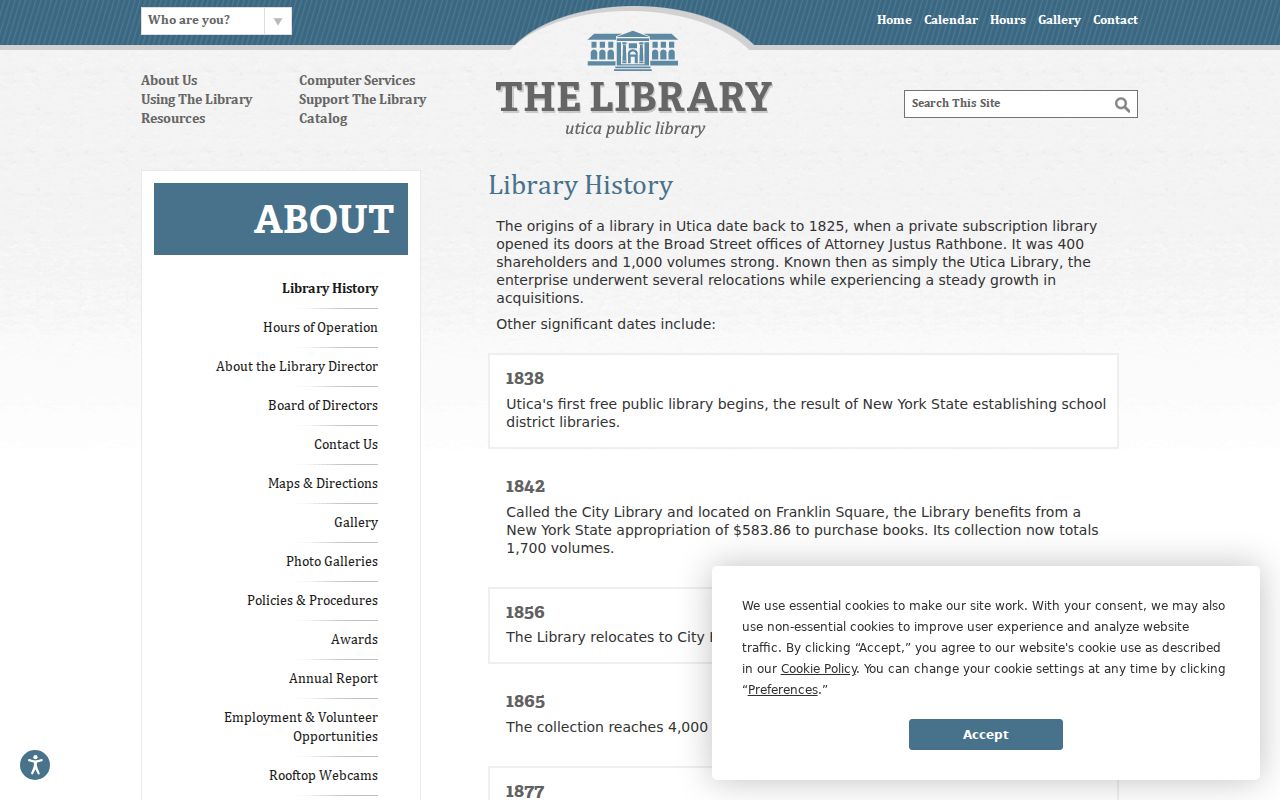
The Library’s historical setting supports a source trail made of dated entries, rather than a claim that a directory name has modern meaning.
Utica's 1884 Map Is a Dated Snapshot
The Library of Congress holds a 20-sheet Utica Sanborn fire-insurance map dated April 1884. Use it to test a street name, block relationship, building footprint, construction or use notation, and the map period. It can strengthen an address chronology when a nearby directory edition gives compatible cross-street clues. It cannot convert an old number to a current number by itself, and it should not be used as a present parcel map.
The County Clerk’s historical-research materials add another fallback. Its genealogy information identifies Regional Records Center holdings that include Utica and Rome directories, newspapers from 1841–1879, historical deeds and mortgages, and selected marriage material. Those holdings sit alongside the Clerk’s terminal and archival-book options when SearchIQS does not supply the needed older record.
The Oneida County Clerk genealogy guide identifies these Regional Records Center research routes.
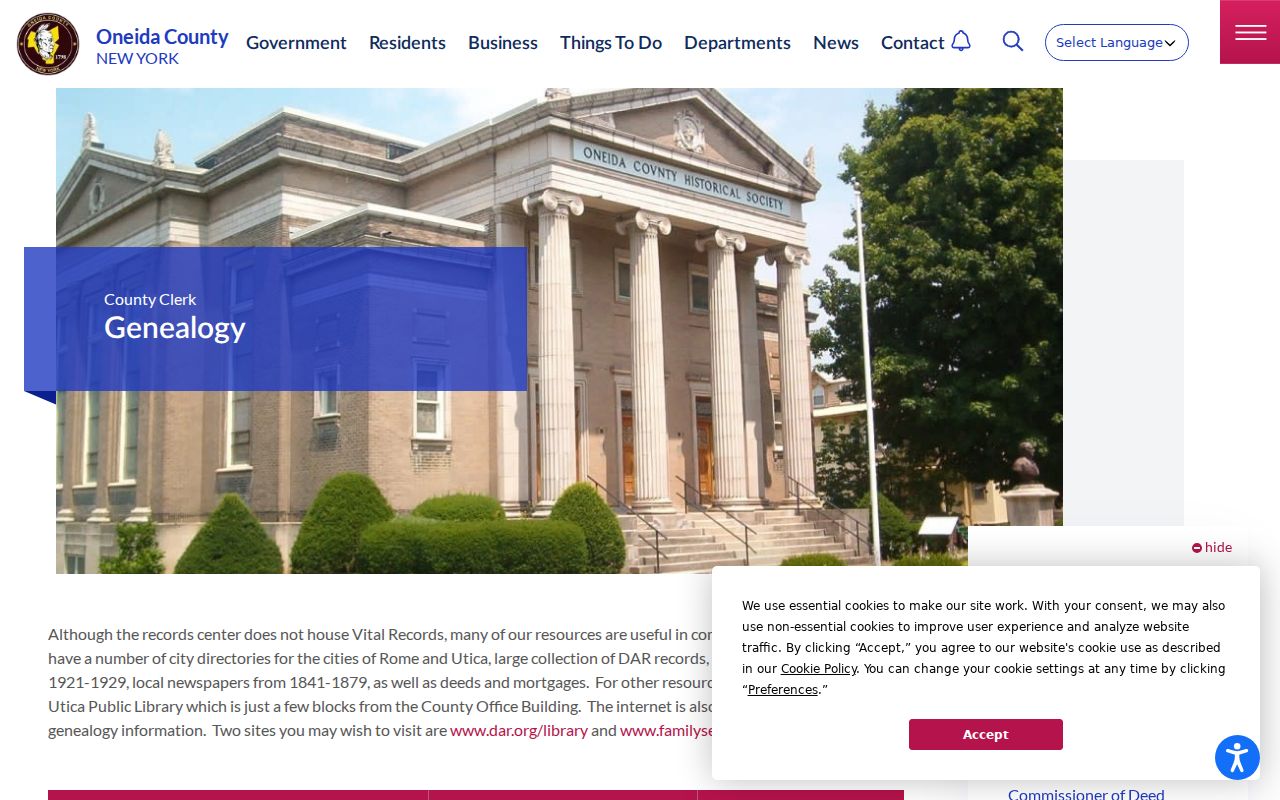
The Clerk’s genealogy material is an archival fallback, not a replacement for the custodian or access rule of a particular document.
Utica Previous Residents in Directories and Census
A deed chain follows land interests. A directory-and-census process asks a separate question about a historical household. UPL lists city directories from 1817, census tools, local yearbooks, cemetery inscriptions, State vital-index microfiche, and newspaper microfilm beginning in 1825. Use the directory entry as printed, including whether it identifies a work site or a residence. The 1828 scan, for example, shows alphabetical entries that may give a trade, work location, and an “r” residence notation. That notation belongs to the edition year.
- Choose a target time from the deed date, map issue, newspaper reference, or other dated event.
- Locate the nearest available UPL directory edition and copy the exact name form, address, page, and work or residence label.
- Check an available edition before and after it. A changed entry is a lead to investigate, not proof of a move or relationship.
- Use UPL census tools and other period sources only when the name, date, and place align with the directory entry.
- Preserve each source separately, then seek a period newspaper, cemetery item, naturalization record, or eligible vital-record route for corroboration.
The historical volumes themselves are described in the Utica city directory collections. For an obituary request, UPL posts no charge for a local obituary, $10 for a New York request, and $15 for another U.S. request when a specific paper and date are supplied.
Utica Addresses Can Remain Unresolved
No authoritative Utica-wide historic street-renumbering conversion table was located in the reviewed sources. That absence is important. A changed number can reflect a move, a printing practice, a different person, a road change, or an actual renumbering. The strongest method compares the directory’s original spelling and cross streets with the closest-period map, the parcel or deed trail, and another dated record. Mark the result as documented, probable, or unresolved.
Modern E911 rules do not fill that historic gap. Oneida County says addresses are a number plus street name, generally with odd numbers on north or west sides and even numbers on south or east sides. New numbering normally uses 40-foot increments, subject to existing conditions. That explains current address administration, but it is not evidence for a past-number conversion.
Note: Keeping an unresolved number visible is more useful than creating a neat address match that the record trail cannot support.
Lawful Limits for Utica Previous Residents
House-history research can support family history, estate questions, property curiosity, and local-history work. It cannot erase source limits. A tax mailing field, deed party, directory resident, map label, and census result each have distinct meanings. Vital records are confidential or eligibility-controlled, voter information has statutory protections, and an Address Confidentiality Program participant has no legitimate research workaround. Preserve the record’s source and date before making any inference.
Lawful use. Use Utica historical records for personal, lawful research and respect protected information. Do not use a past-resident trail to stalk, harass, intimidate, or harm a living person.
When records disagree, ask the office that holds the record about its fields or request procedure. The responsible conclusion is often limited: a document places a named party or printed listing at a particular time, and no more.