
Utica City Directory Holdings
The Utica Public Library digital collection is the first stop for a dated Utica city directory entry. It begins with 1817 and provides selected scanned editions through 1951. Those scans are a valuable online run, not an unbroken annual series. Start with the edition nearest a known marriage, deed, school reference, obituary, or newspaper item, then note the edition year and page before drawing any conclusion.
| Collection | Years | Where Held | Access |
|---|---|---|---|
| UPL digitized Utica City Directories | Selected 1817-1951, with gaps | Utica Public Library online collection | Browse annual scans online |
| UPL local directory and genealogy materials | Directories beginning in 1817 | Utica Public Library Genealogy Room | In person while the room is staffed |
| New York State Library Utica holdings | Early volumes; microfiche for much of the 1800s; microfilm 1861-1935 | State Library 7th-floor microform area | Noncirculating microform use |
| Regional Records Center local-history holdings | Utica/Rome directories and newspapers, plus historical land materials | Oneida County Clerk genealogy route | Confirm the particular holding and access method |
| OCHC research-library collections | Local documents, images, artifacts, and related history materials | Oneida County History Center | Appointment visit or prepaid research service |
Each shelf answers a slightly different need. UPL supplies the most direct digital browsing route. The State Library can bridge an online gap with microform. The County and the Oneida County History Center, often called OCHC, add local context instead of an assumed complete directory run.
See the UPL directory collection before choosing an edition. Its public list is the source for the scans shown here.
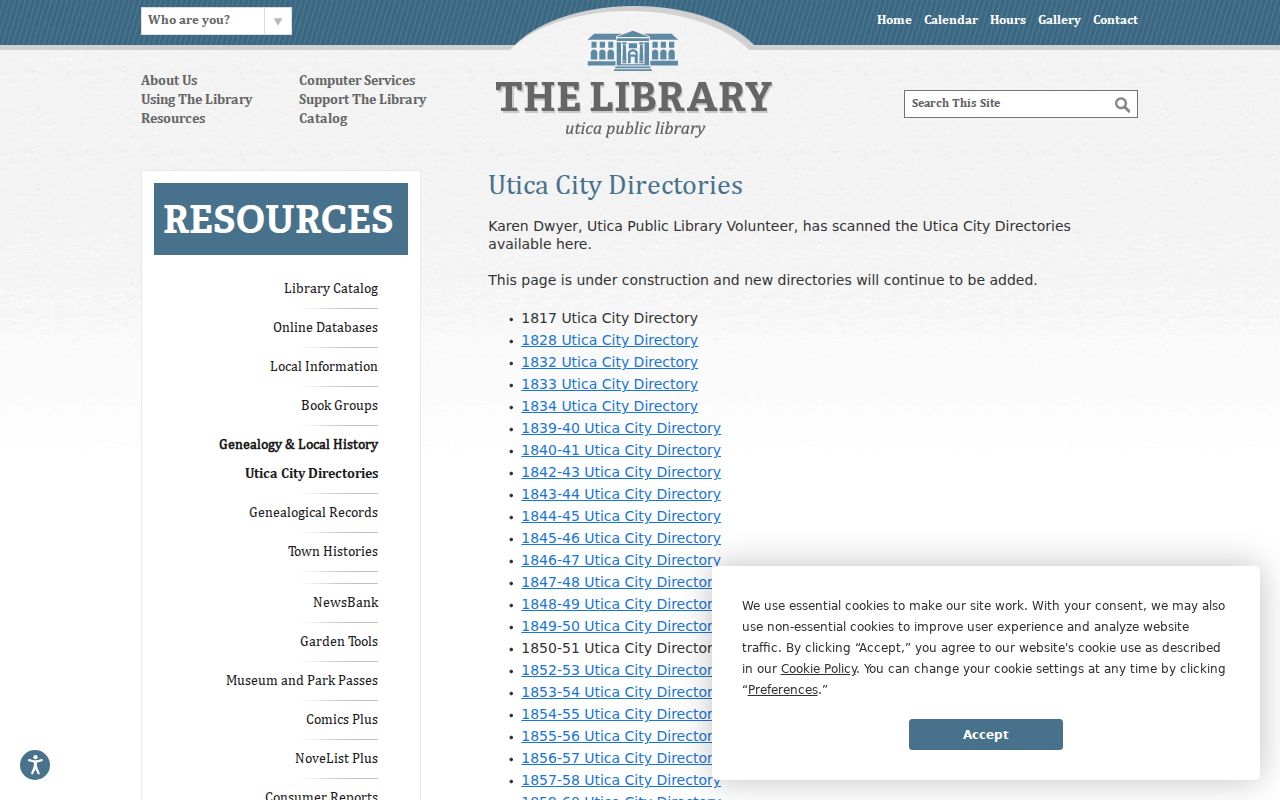
The browse-by-year format makes it practical to record the exact edition and page rather than relying on a search snippet.
Utica Directory Years Online
The displayed UPL run includes 1817; 1828; 1832-34; 1839-40 through 1868-69; 1869-70; 1870-76; 1879-80; 1882-84; 1886-90; 1892-99; 1902; 1905-09; 1911-12; 1914-17; 1919-21; 1923-24; 1926-28; 1930-33; 1935-43; 1945; 1947-49; and 1951. That list shows real gaps, including 1877-78, 1881, 1885, 1891, 1900-01, and several later single years. An absent edition in the online list is not proof that no physical copy survives elsewhere.
| 1817 | First year in the UPL digitized Utica directory collection. |
|---|---|
| 1828 | Institutional scan that visibly demonstrates alphabetical entries, trade, work location, and “r” residence notation. |
| 1861-1935 | Utica microfilm span identified in the New York State Library holdings guide. |
| 1951 | Last selected year displayed in the UPL digitized run. |
UPL identifies volunteer Karen Dwyer as the scanner and says additional material is being added. The safest citation names the work as Utica City Directory, gives the exact edition year, and retains the scan link. Original publishers changed over time. For example, an established catalog identifies C. N. Gaffney for the 1860-61 volume, so one publisher name should never be assigned to the whole series.
Use the Utica Public Library Genealogy Room when an online scan is unclear or a companion source is needed.
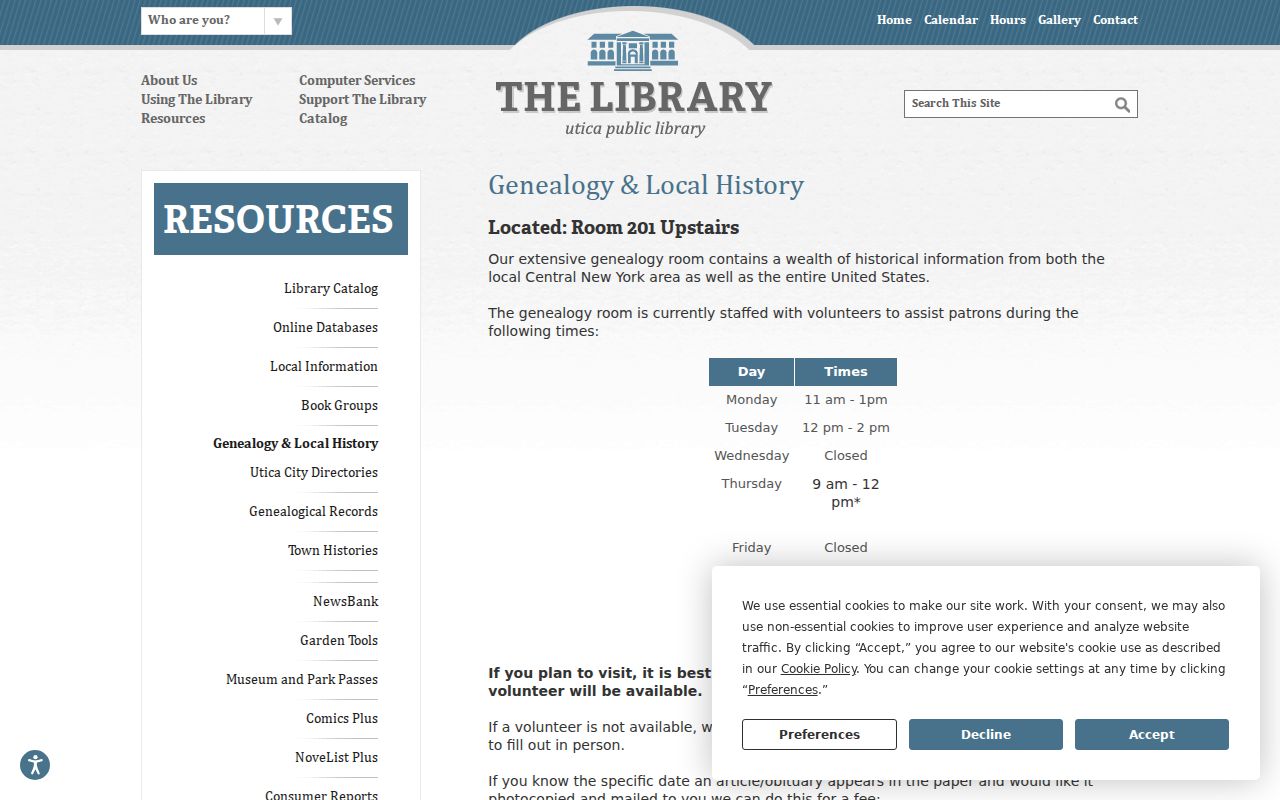
The Library combines city directories with cemetery inscriptions, yearbooks, census tools, and newspaper microfilm, which can test a dated listing.
Utica City Directory Research Rooms
For a missing Utica city directory year, the New York State Library city-directory guide is the next documented route. Its Utica listing includes early nineteenth-century volumes, microfiche through much of that century, microfilm from 1861 through 1935, and selected telephone directories into the mid-twentieth century. The microform is used in the Library's 7th-floor area and does not circulate. Confirm an annual volume with the institution before planning a visit.
UPL also offers local city directories, newspaper microfilm beginning in 1825, and limited staffed Genealogy Room hours. When volunteers are not scheduled, it directs researchers to its in-person reference service. The Library posts separate obituary-copy charges when a requester supplies a specific newspaper and date, another reason to narrow a request before sending it.
The State Library's Utica holdings guide documents the physical microform fallback for a missing digital edition.
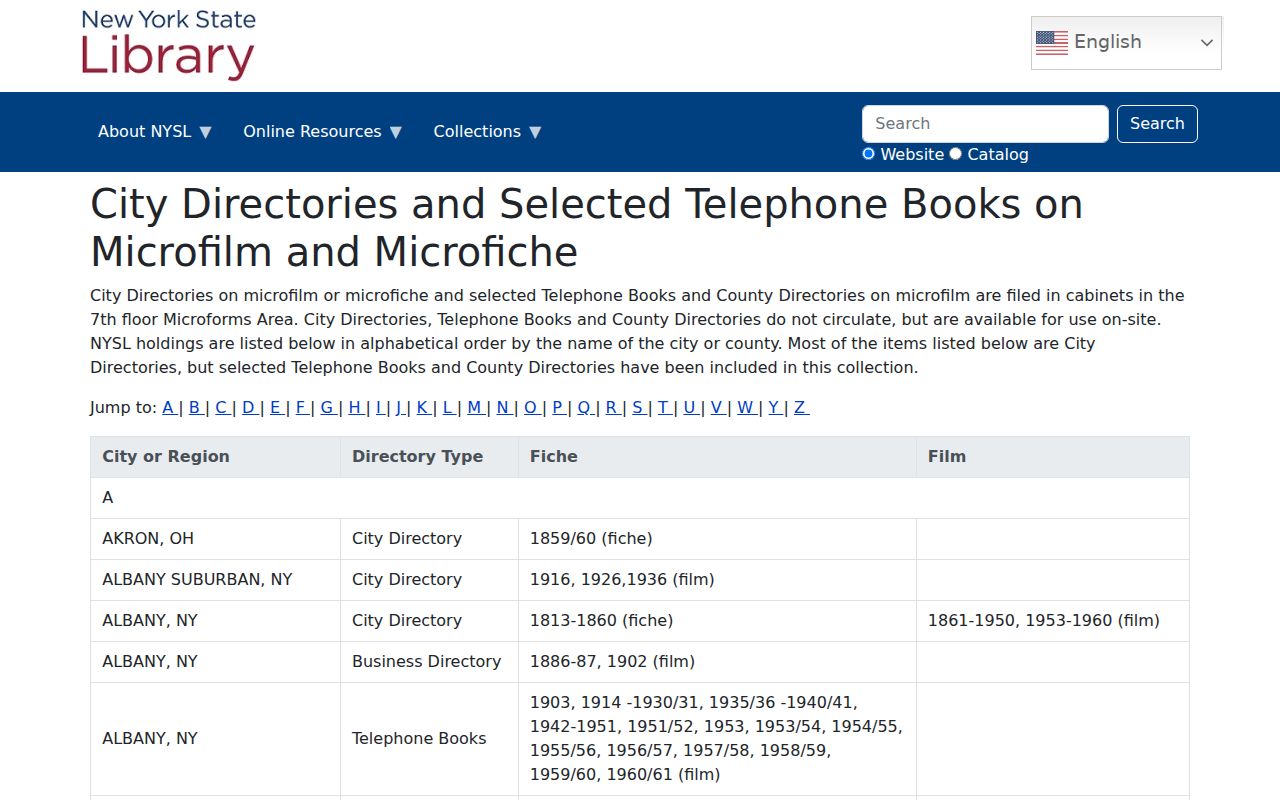
That second access channel matters because a scan gap is an invitation to check a catalog, not a reason to erase a year from a household timeline.
The Oneida County History Center research library is a complementary Utica stop. Its Colonel Tharratt Gilbert Best Research Library holds more than 250,000 documents and books, major image collections, and artifacts. Visits are by appointment Monday through Friday, 10-4; the posted nonmember visit fee is $10, members enter free, and research services are prepaid.
Review the History Center's online research collections before an appointment.

OCHC is especially useful when a directory needs a photograph, cemetery lead, church-related context, or another local document alongside it.
The History Center visit page explains its appointment and research-service route.

A planned visit can turn a single printed name into a documented local-history question without treating the library as a vital-record office.
The County Clerk's genealogy information identifies Regional Records Center holdings that include Utica/Rome directories, newspapers from 1841-1879, historical deeds and mortgages, and selected marriage material. It is a local-history route, not a vital-record custodian. Use it to locate supporting evidence, then ask the City Registrar or NYSDOH for any record that requires official vital-record access.
Reading a Utica City Directory Entry
An 1828 Utica city directory scan shows how compact an entry can be. Entries are alphabetical and may combine a printed name, trade, work location, and a residence marked with “r.” The Stephen Abbey entry in that volume, for example, places a turner at a Genesee Street work location and gives a residence notation. It illustrates the source's layout, not a modern identity claim.
| Listed name | Use the spelling and form printed in that edition, even when a later source differs. |
|---|---|
| Trade or occupation | Read it as a contemporaneous directory label, not a statement about every year of a life. |
| Work location | Keep a business address separate from a residence. |
| “r” notation | Read it as the residence notation for that edition's timeframe. |
| Street number | Test it against period maps and records before comparing it with a modern number. |
Transcribe the entry as printed and preserve the page image. An omission can reflect timing, spelling, a temporary stay, a shared business, or an OCR problem. It does not settle whether a person was absent from Utica.
- Criss-cross directory
- A street-order section, when a particular volume provides one, that can be used to compare listed addresses. Check the edition's own layout first.
- Householder index
- An index that names householders rather than every possible member. Its presence and coverage must be checked in the volume being used.
- Abbreviation key
- The volume's explanation of short forms. Photograph or note it before expanding marks such as “r” in a citation.
Trace a Utica Directory Household
A household trail works best as a sequence of edition-specific observations. Start from a known event year, search surname variants and initials, and write down whether the printed address is residential or commercial. Then compare the closest available editions on both sides of the event. A move, trade change, or disappearance is a lead to test, not an answer by itself.
- Choose an edition near a known address, deed, school reference, newspaper item, or family event.
- Record the year, page, spelling, printed address, trade label, and residence mark exactly as shown.
- Check one available edition before and after, preserving every change rather than smoothing it into one narrative.
- Pair the directory years around each federal census year with UPL census resources, then compare name, place, and timing.
- Use a period newspaper, cemetery source, naturalization record, or vital index only when its date and locality fit the listing.
UPL's newspapers, yearbooks, and cemetery material can add context, while the State Archives and the appropriate vital-record custodian handle different record questions. A historic directory result should always retain its edition year in the final note.
Note: A directory disappearance may reflect a move, death, omission, or changed listing practice, so compare nearby editions before choosing an explanation.
Utica Atlases Test Directory Addresses
A city directory address is a historical address, not a ready-made modern parcel match. The New York Public Library's historic Utica atlas collection is one institutional way to test street alignment and cross-street clues. The Library of Congress also holds a 20-sheet April 1884 Utica Sanborn map. Use a map issue for its own date, not as a conversion table for every street number.
No authoritative Utica-wide historic renumbering conversion was located in the reviewed sources. Compare the directory's cross streets, a period map, and City or County parcel history. If the chain does not establish a match, label the address relationship unresolved.
Browse the NYPL historic atlas collection as a date-specific companion to a directory entry.
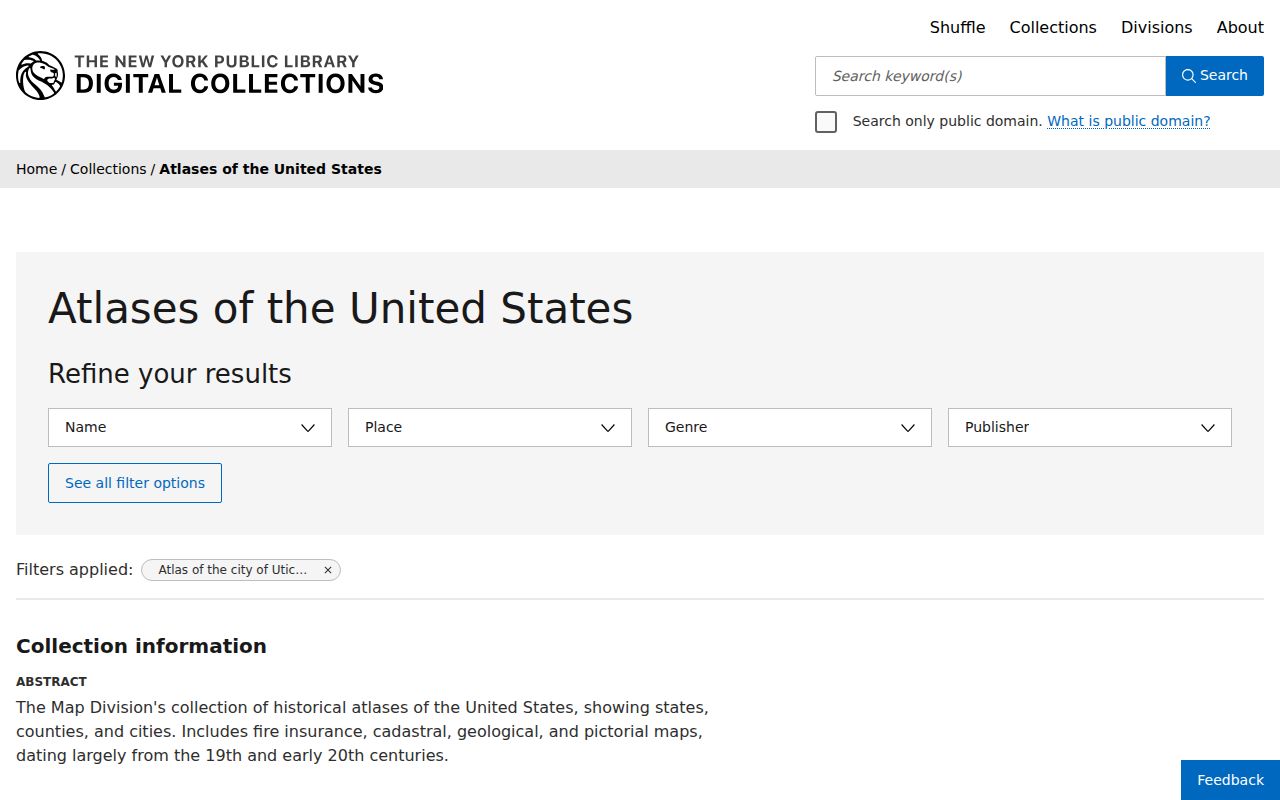
The atlas route helps test a printed street context while leaving unsupported number conversions open for later research.
Comparing Utica Directory Access
The useful comparison is not online versus offline in the abstract. UPL scans are best for a quick dated reading and shareable page citation. State Library microforms are the documented fallback when the digital sequence skips a year. OCHC and Regional Records Center materials add local evidence around a listing, but neither should be presented as a substitute for a restricted certificate or as an automatically complete directory series.
That distinction is a practical local advantage. It keeps a family-history search from ending at the first missing PDF and directs the next step to the repository most likely to hold a neighboring source. The research path stays auditable because each item keeps its custodian and date.
Preserve Each Utica Directory Citation
For every Utica city directory observation, retain the source title, repository or scan URL, edition year, page or image, exact printed name, exact address, and whether the line concerns work or residence. Separate what the page says from any later inference. This small citation bundle prevents a directory resident, a deed party, and a tax-mail recipient from becoming one untested identity.
When the goal shifts from historical household context to a present official record, use the custodian that owns that record. The historical shelf is strongest when it remains a dated source rather than being stretched into proof of current facts.